
A driveway is only as good as its base
Sinking, rutting, cracked edges and puddles nearly always start below the surface. We dig out to firm ground, lay and compact a crushed-stone sub-base in layers, set kerbs and edgings to line and level, and build in falls so rainwater runs where it should.
It’s the same method our crews use on commercial forecourts and car parks, scaled to suit a home.
Driveway surfaces we install
Every surface has its strengths. At the site visit we’ll talk through the options based on how you’ll use the driveway, the look you want and how water drains on your plot.
Tarmac driveways
Tarmac (asphalt) is hard-wearing, quick to lay and good value over larger areas. It goes down hot in two layers, a binder course and a finer surface course, and is rolled to a tight finish that copes well with turning cars and heavier vehicles.
Resin-bound driveways
Resin-bound surfacing mixes natural aggregate with a clear resin and trowels it to a smooth, even finish. Laid over a porous base it lets rainwater soak through, which helps with the drainage rules for front gardens. It isn’t the same as resin-bonded, where loose stones are scattered over a coat of resin. That finish is rougher underfoot and isn’t permeable.
Block paving
Concrete block paving gives you the widest choice of colours, patterns and borders, and individual blocks can be lifted and relaid if anyone ever needs to reach the services below. Permeable block paving is an option where drainage is a concern.
Concrete driveways
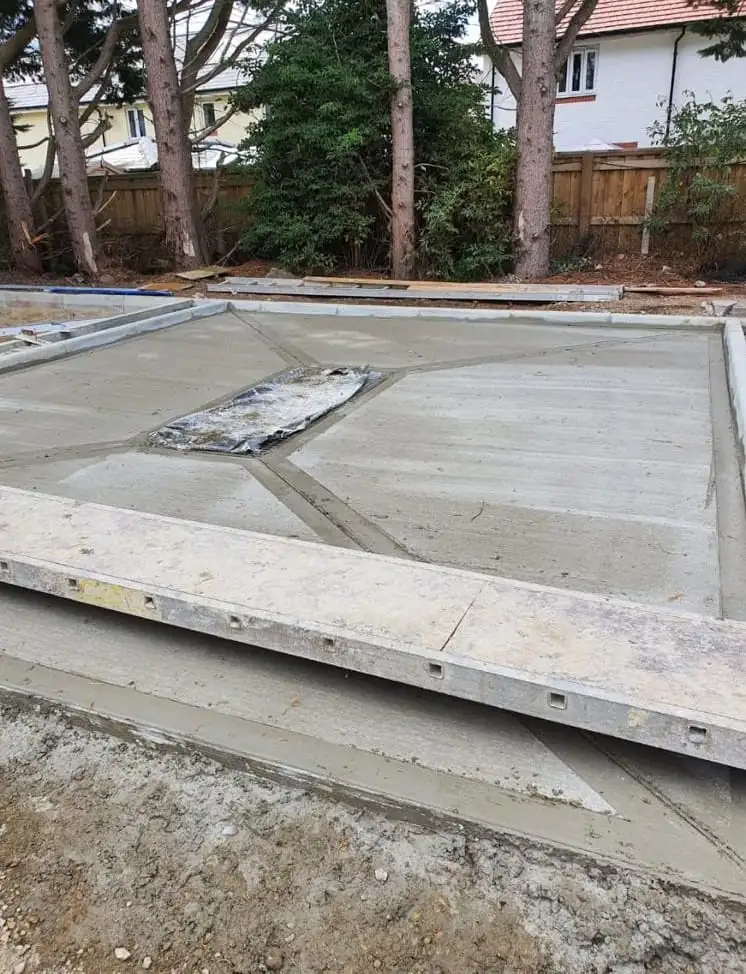
A reinforced concrete slab is strong, low maintenance and well suited to plain, practical driveways, parking bays and hardstandings. We pour, finish and cure the concrete ourselves, with joints placed to control cracking.
Drainage, planning and dropped kerbs
Rainwater has to go somewhere, so we plan the falls, channels and soakaways before any surface goes down. In England there’s also a specific rule for front gardens. You don’t need planning permission for a new or replacement driveway if it uses a permeable surface, or if the water runs off onto a lawn or border within your property. A traditional, non-permeable surface covering more than five square metres that drains towards the road does need planning permission.
Planning a new or wider dropped kerb? The pavement and kerb are part of the public highway, so the crossing has to be approved by BCP Council, the highway authority for Bournemouth, Christchurch and Poole, before any work on the footway starts.
Trees are worth checking too. Bournemouth has a lot of mature trees, many of them protected by Tree Preservation Orders, and digging that could damage a protected tree’s roots needs BCP Council’s consent first. We’ll flag it at the site visit if a tree is close to your driveway.
How a driveway project runs
- Site visit. We look at the area, levels, access, existing drainage and any services, and talk through surfaces.
- Quotation. You get a written price and scope for the dig-out, base, edgings and the surface you’ve chosen.
- Excavation. The old surface and soil come out to the depth the new driveway needs.
- Base and drainage. We lay and compact the sub-base in layers and install the kerbs, edgings, channels or soakaways.
- Surfacing. The tarmac, resin, blocks or concrete go down, and we leave the site clean and tidy.

Built by a groundworks contractor
All Groundworks Southern is a Poole-based groundworks company with a team of over 50 people. Much of our work is commercial, with forecourts, car parks, highways and deep drainage for clients including Lidl, EG Group and the Ministry of Defence.
So the people building your driveway understand compaction, levels and drainage properly, and they bring the right plant for the job.
Proudly Partnering With


Driveway questions
How long does it take to lay a new driveway?
It depends on the size, the surface and how much has to be dug out first. We confirm the timings after the site visit and set them out with your quote, so you know how long you’ll be without the use of your drive.
Which driveway surface is best?
There’s no single answer. Tarmac is practical and durable, resin-bound looks smart and drains well, block paving gives the most design choice, and concrete is the toughest for heavy use. We’ll recommend what suits your property, how you use it and your budget.
Do I need planning permission for a new driveway?
Not usually, as long as the surface is permeable or the water drains onto your own garden. A non-permeable front driveway over five square metres that drains towards the road needs planning permission. Listed buildings and some conservation areas have extra controls, so check with BCP Council if either applies to your home.
Can you lay a new surface over my old driveway?
Sometimes. If the existing base is sound and the levels work, an overlay can be an option for some surfaces. If the old driveway is cracked, sinking or holding water, the problem is usually underneath and it needs digging out and rebuilding. We’ll tell you which applies at the site visit.
Do you work outside Bournemouth?
Yes. We’re based in Poole and lay driveways in Poole and across the rest of Dorset, including Christchurch.
Do you surface commercial sites as well?
Yes. We build and resurface car parks, forecourts and access roads for commercial clients. See our car park construction and surfacing page for more.