
Car parks built from the ground up
A car park takes constant punishment from turning wheels, heavy vehicles, standing water and frost. How long the surface lasts depends on what’s underneath, so we put as much care into the formation, sub-base and drainage as into the finish.
Our team has delivered surfacing and drainage on commercial sites including the Salisbury Riverside Project, Castlepoint Shopping Centre in Bournemouth and a petrol station forecourt in Salisbury.
What our car park works include
- Site clearance, breaking out old surfaces and excavation to formation level
- Ground preparation and a properly compacted sub-base
- Surface water drainage, including gullies, channel drains, attenuation and soakaways
- Petrol and oil interceptors for forecourts and service areas
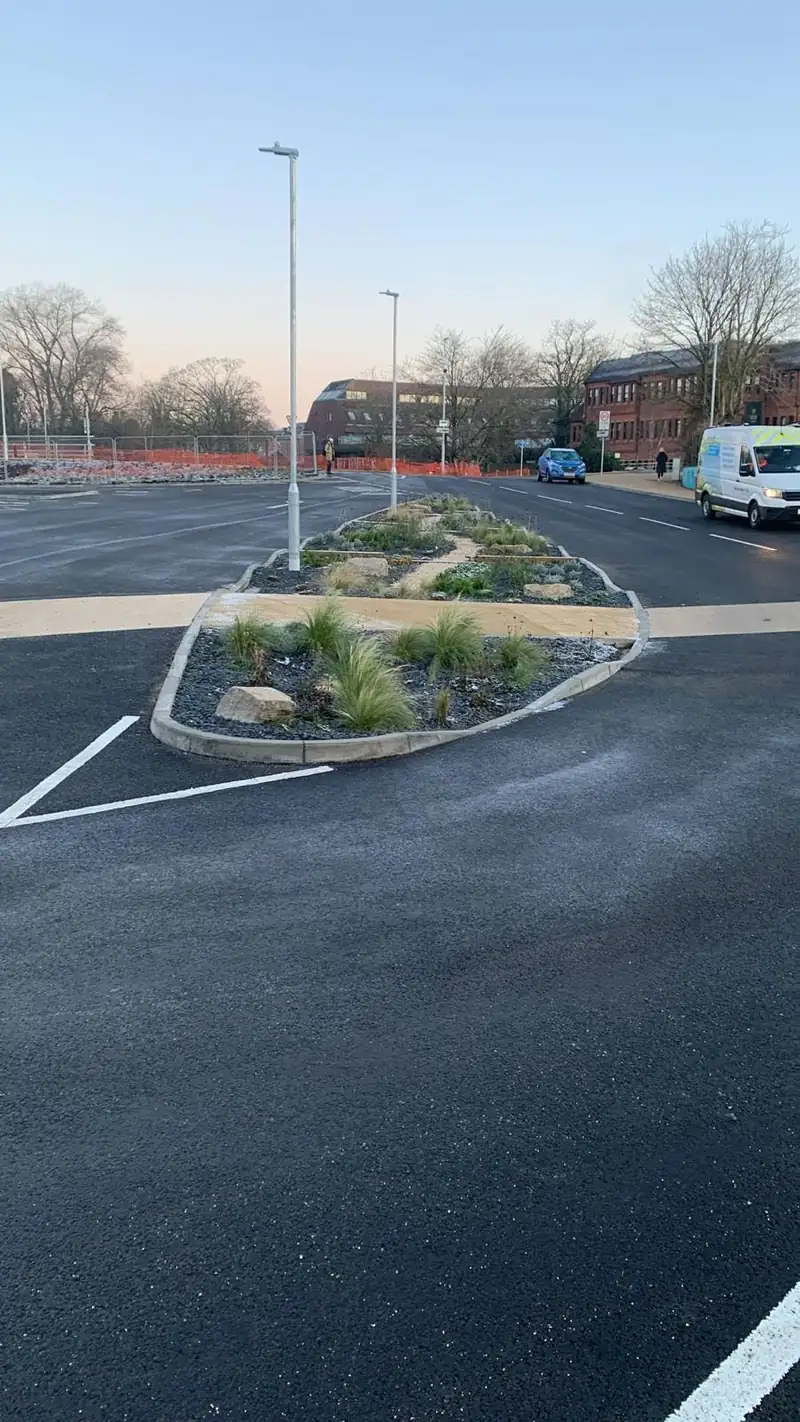
- Kerbs, edgings, islands and planting beds
- Footways, dropped kerbs and tactile paving for safe pedestrian routes
- Ducting for lighting, barriers, CCTV and electric vehicle charging points
- Tarmac, concrete or block paving surfaces
- Resurfacing and repairs to existing car parks
Choosing the right car park surface
Tarmac
Tarmac (asphalt) is the most common choice for car parks. It’s quick to lay over large areas, smooth to drive on and straightforward to patch or resurface later. Laid as a binder course and a surface course, it can be specified for cars alone or for heavier delivery vehicles.
Concrete
Reinforced concrete is the strongest option for areas that take heavy, concentrated loads, such as service yards, delivery bays, forecourts and car wash bays. It stands up to fuel and oil spills far better than asphalt and needs very little maintenance.
Block paving and permeable paving
Block paving suits smaller car parks, parking bays and pedestrian areas, and bays can be picked out in contrasting blocks. Permeable block paving lets rainwater pass through into the sub-base, which can reduce the need for gullies and pipework and help meet sustainable drainage requirements.
Drainage and planning requirements
Most new car parks need a drainage strategy as part of the planning application, and councils increasingly expect sustainable drainage (SuDS) that controls how quickly water leaves the site. Depending on the ground and the design, that can mean permeable paving, attenuation tanks or soakaways, with interceptors wherever fuel or oil could get into the system.
If the car park needs a new or altered entrance from a public road, those works usually fall under a Section 278 agreement with the highway authority. We build Section 278 highway works too, so the entrance and the car park can be delivered as one package.
Working around a site that stays open
Many car park projects happen while a shop, business or public building keeps trading. We can phase the works so parts of the car park stay usable, keep pedestrian routes safe and agree access, deliveries and working hours with you before we start.

Forecourts, retail and commercial sites
For Euro Garages in Salisbury we refurbished a forecourt, built car wash bays, installed petrol interceptors and carried out extensive concrete works and resurfacing.
Our clients also include Lidl, EG Group and the Ministry of Defence, and we’re based in Poole with a team of over 50 people.
Proudly Partnering With


Car park questions
How long does it take to build or resurface a car park?
It depends on the size, the condition of the existing surface and how much of the site has to stay open. Resurfacing can be quick, while a new car park with drainage and kerbs takes longer. We set out a programme with our quote.
Can you resurface our car park without closing it?
Often, yes. Splitting the work into phases keeps part of the car park in use, and some work can be done outside opening hours. We’ll agree the phasing with you at the start.
What is the best surface for a car park?
Tarmac suits most car parks. Concrete is better where there are heavy loads or a risk of fuel spills, and permeable block paving is worth considering where drainage is restricted. We’ll recommend the right build-up for your site.
Do you install car park drainage?
Yes. Drainage is one of our core services, from gullies and channel drains to attenuation, soakaways and interceptors, all connected into the wider site system. See our deep drainage page for more.
Where do you work?
We’re based in Poole and work across Dorset, including Bournemouth, Christchurch and Weymouth, and into Hampshire and Wiltshire.